2026
submitted
Four hyperplanes do not always equipartition a mass in ℝ⁴
A smooth positive density in four dimensions that admits no equipartition into sixteen equal parts by four affine hyperplanes.
Research
My research lies in discrete geometry and topological combinatorics. I am interested in how combinatorics, algebraic topology, and linear algebra interact in problems about partitions and intersections.
The topics below overlap: a paper can belong to more than one area. The publication catalog includes the full list; selected papers follow the topic overview.
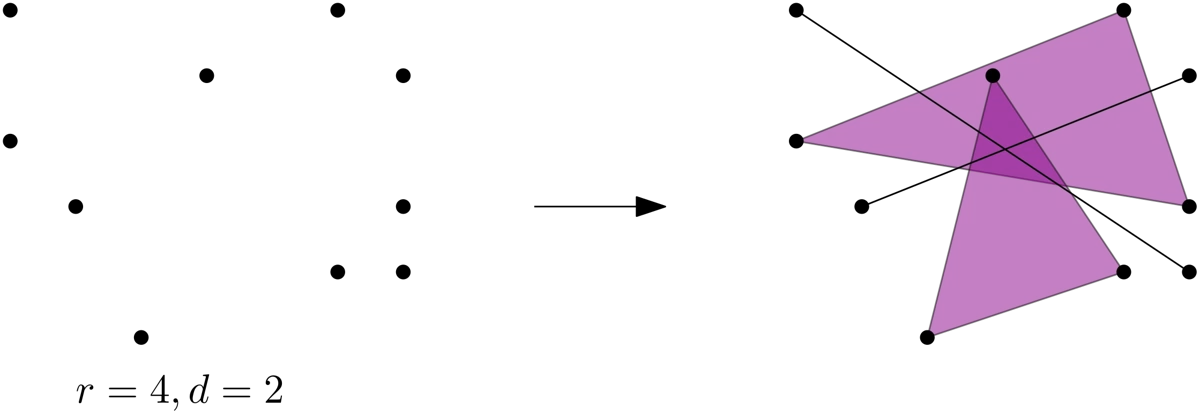
Partitions, convex hulls, and intersection patterns. Colorful, tolerant, quantitative, and topological versions of Tverberg’s theorem.
29 papers
Fairly dividing measures using hyperplanes and other geometric shapes, with connections to topology and convexity.
16 papers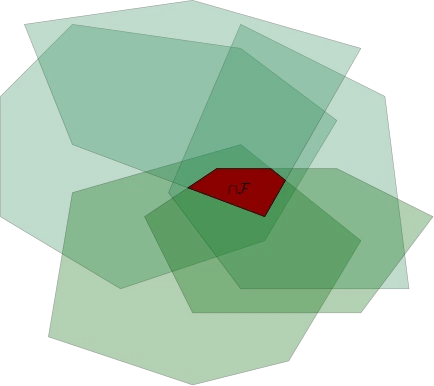
How local intersection conditions force global conclusions. Colorful, fractional, and quantitative forms of Helly’s theorem.
17 papers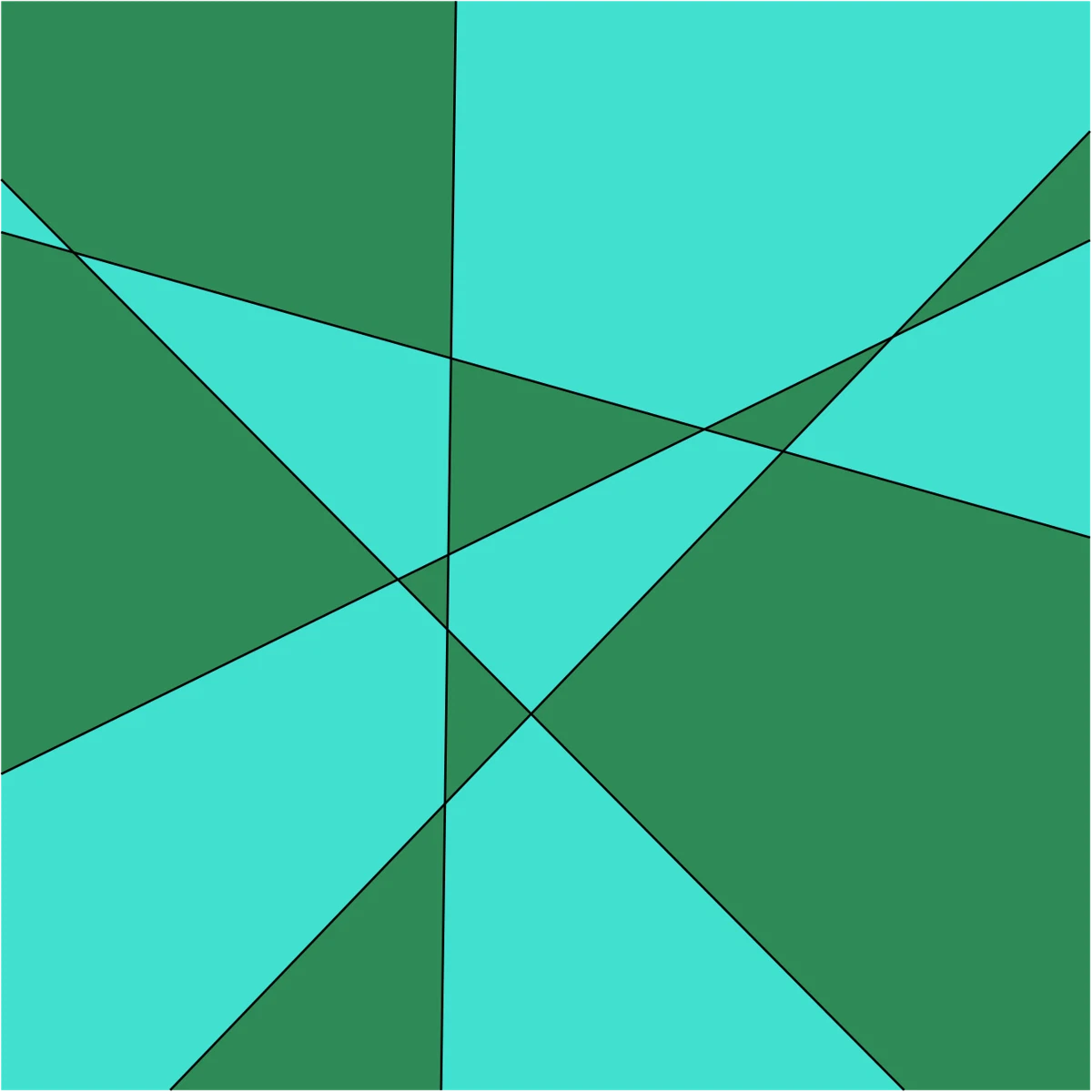
Using topology to organize combinatorial choices: Borsuk–Ulam and KKM theorems, selection structures, and configuration spaces.
15 papers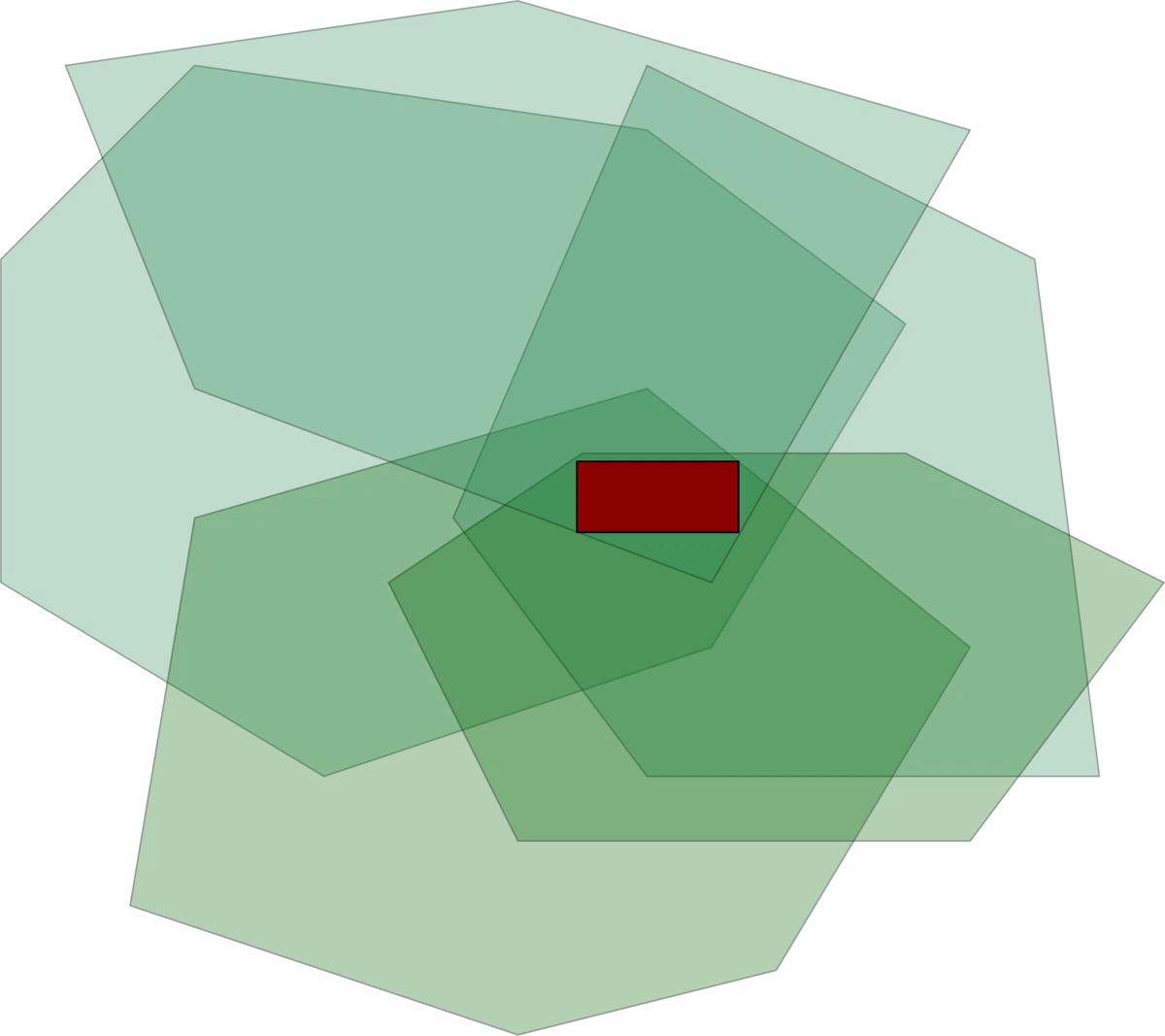
Transversals, quantitative intersection theorems, convex sets, and geometric depth.
19 papers
Graph homomorphisms, partition functions, geometric graphs, and crossing numbers.
5 papers
Envy-free partitions and fair allocations, studied through geometric and topological methods.
3 papers
Connections between discrepancy, probabilistic methods, and geometric partitions that tolerate deletions.
2 papers
Realizing prescribed symmetry groups and automorphisms in convex polytopes.
2 papersA curated selection
A smooth positive density in four dimensions that admits no equipartition into sixteen equal parts by four affine hyperplanes.
Selection structures extend the role of color classes and matroids in KKM theorems and discrete geometry.
Topological Tverberg cores, vertex-deletion tolerance, and consequences for Kalai’s cascade conjecture.
Discrete Comput. Geom. 71 (4), 1381–1402.
Trans. Amer. Math. Soc. 379 (2026), no. 5, 3665–3691.
Combinatorics, Probability and Computing 27 (3), 427–440.